

“My beloved ones, you yourselves will experience in your lives, even on this earth, that all of the perfection of holiness, all the fervor of action, all the usefulness of the missionary ministry consists not in great wisdom, nor in great intelligence, not in great skills or even in the amount of prayer and penitence, but solely in the perfection of holy Obedience. (KW 380)
St. Maximilian Kolbe
In September of 2024 we traveled to Poland on Pilgrimage. One year later many experiences during our time there have remained in my heart still today.
Our time spent in Auschwitz was a particularly poignant one.

I believe I experienced many of the same feelings most do while walking through the concentration camp. Extreme sorrow, grief, outrage, disbelief. However, one feeling that unexpectedly overwhelmed me was courage.
Unimaginable courage.
The Auschwitz camp complex was the largest of its kind established by the Nazi regime. Auschwitz consisted of three main camps, including an extermination center. Individuals not sent directly to the gas chambers were sentenced to forced labor. More than 1.1 million people were murdered at Auschwitz.
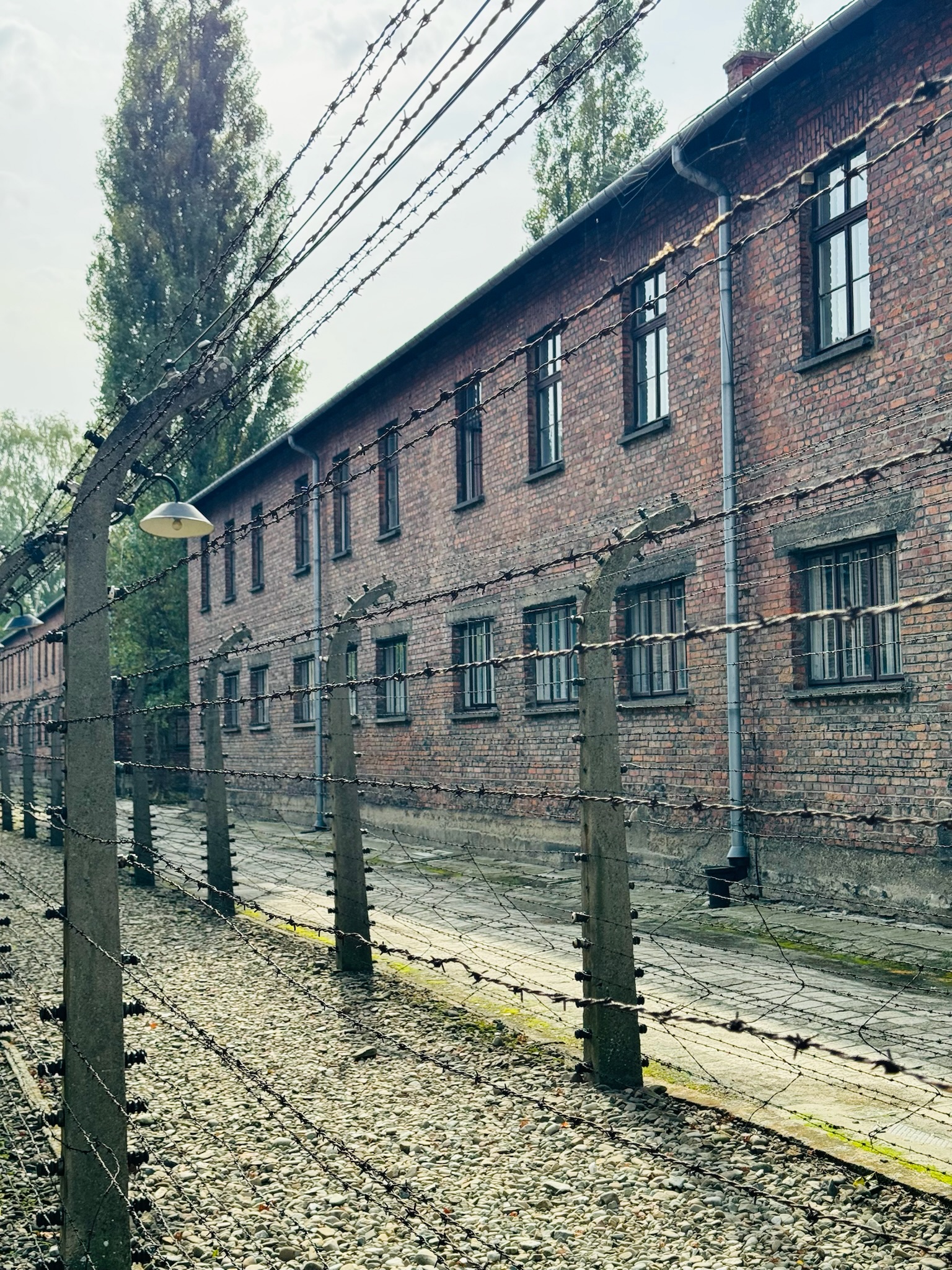
Until early 1942, the Nazis deported to Auschwitz a relatively small number of Jews, who were sent there along with the non-Jewish prisoners, mostly Poles, who accounted for the majority of the camp population until mid-1942. Extant records from the period January-December 1941 indicate that—not counting Soviet POWs—17,270 prisoners were registered in Auschwitz, of whom 1,255 were Jews.
*However, In 1942-1944, as part of the “final solution of the Jewish question” (Endlösung der Judenfrage), Auschwitz served as the largest Nazi center for the destruction of the Jewish population of the European countries occupied by and allied to the Third Reich. The majority of the Jews who arrived in Auschwitz in transports organized by the Reich Main Security Office (RSHA), at least 1.1 million people including more than 200 thousand children and young people, were killed in the gas chambers immediately or soon after arrival.
After the liquidation of the Polish state and its institutions, the fundamental goal of German policy in occupied Poland was the exploitation of material and labor resources, and the removal of the local Polish population and ethnic minorities. This was done through expulsion and systematic extermination. The Polish lands were to be completely germanized, through German settlement in the depopulated area.
Hitler repeatedly told German dignitaries and leaders as much. After the meeting between General Governor Hans Frank and Hitler on March 17, 1941, Frank wrote:
“The Führer is determined to make this country a purely German country within 15-20 years. From now on, the term “seat of the Polish people” will no longer be used to refer to the GG and adjacent areas […] The General Government is to become the German zone in the future. In the place inhabited today by over 12 million Poles, 4-5 million will live in the future. The General Government is to be a country as German as the Rhineland.”
From the beginning of the occupation various places of imprisonment – police jails, judicial prisons, transit camps, labor camps, reeducation camps, penal camps and, above all, concentration camps played an important role in the process of the systematic extermination of the Poles, the weakening of their intellectual potential, and the imposition of unquestioning obedience.
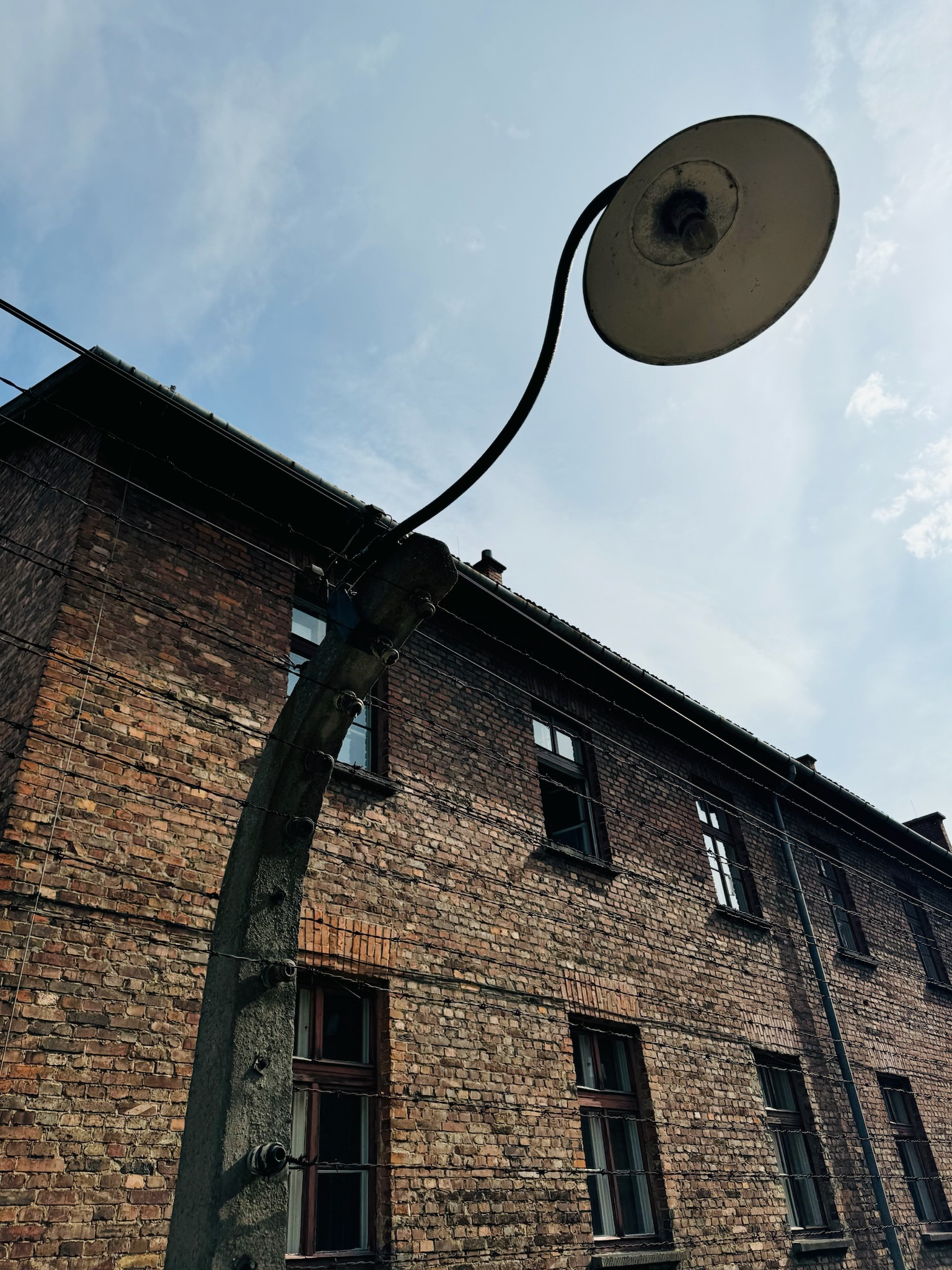
The Auschwitz concentration camp – created 10 months after the beginning of the war – was the first concentration camp built in occupied Polish territory. Together with Majdanek (created in 1941) and Stutthof it was one of the main places of deportations and annihilation of Poles. The first transport of Polish political prisoners arrived at the Auschwitz camp on 14 June 1940. On that day Germans deported 728 people from a prison in Tarnów.
In addition to those in breach or suspected breach of the orders of the occupying authorities and activities in the resistance movement, persons who prior to the war, due to their education, activities and social position had a considerable standing in the society, were also imprisoned in the camp. They were pre-war government officials, politicians, schools teachers at different levels from basic to higher education institutions, doctors, professional army officers, the clergy and nuns. According to the Germans, they were particularly predisposed to resist the occupant. All these people, regardless the reasons of the arrest were considered political prisoners. So began the fate of Fr. Maximilian Kolbe.
Maximilian Kolbe was a Polish priest who died as prisoner 16770 in Auschwitz, on August 14, 1941.
When a prisoner escaped from the camp, the Nazis selected 10 others to be killed by starvation in reprisal for the escape. One of the 10 selected to die, Franciszek Gajowniczek, began to cry: My wife! My children! I will never see them again! At this Maximilian Kolbe stepped forward and asked to die in his place. His request was granted …
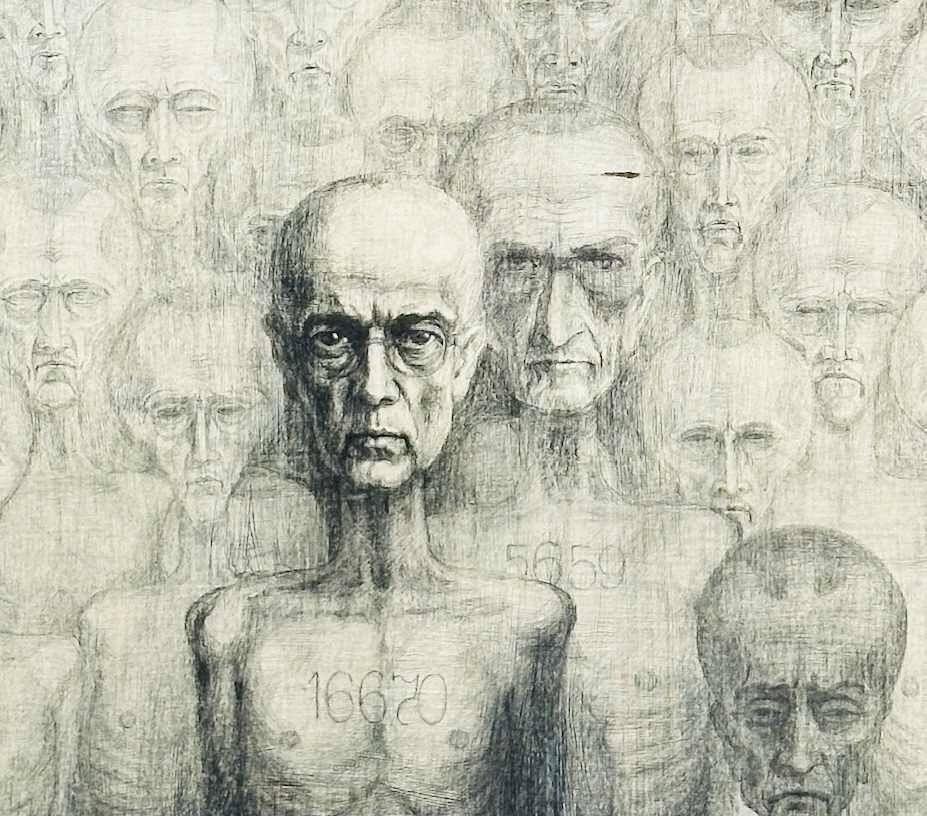
The story begins on 8 January, 1894 – Raymond Kolbe was born the second son of a poor weaver at Zdunska Wola near Lodz in Poland. In his infancy Raymond seems to have been normally mischievous but one day, after his mother had scolded him for some mischief or other, her words took effect and brought about a radical change in the child’s behavior. Later Raymond explained this change:
‘That night I asked the Mother of God what was to become of me. Then she came to me holding two crowns, one white, the other red. She asked if I was willing to accept either of these crowns. The white one meant that I should persevere in purity, and the red that I should become a martyr. I said that I would accept them both.’
Thus early did the child believe and accept that he was destined for martyrdom. His belief in his dream coloured all his future actions.
In 1910 he became a Franciscan, taking the name Maximilian. He studied at Rome and was ordained in 1919. He returned to Poland and taught Church history in a seminary. He built a friary just west of Warsaw, which eventually housed 762 Franciscans and printed eleven periodicals, one with a circulation of over a million, including a daily newspaper.
In 1930 he went to Asia, where he founded friaries in Nagasaki and in India. In 1936 he was recalled to supervise the original friary near Warsaw. When Germany invaded Poland in 1939, he knew that the friary would be seized, and sent most of the friars home. He was imprisoned briefly and then released, and returned to the friary, where he and the other friars began to organize a shelter for 3,000 Polish refugees, among whom were 2,000 Jews. The friars shared everything they had with the refugees. They housed, fed and clothed them, and brought all their machinery into use in their service. Inevitably, the community came under suspicion and was watched closely. Then in May 1941 the friary was closed down and Maximilian and four companions were taken to the deathcamp Auschwitz, where they worked with the other prisoners.
On June 15, 1941, he managed to write a letter to his mother:
‘Dear Mama, At the end of the month of May I was transferred to the camp of Auschwitz. Everything is well in my regard. Be tranquil about me and about my health, because the good God is everywhere and provides for everything with love. It would be well that you do not write to me until you will have received other news from me, because I do not know how long I will stay here. Cordial greetings and kisses, affectionately. Raymond.‘
One day an SS officer found some of the heaviest planks he could lay hold of and personally loaded them on the Franciscan’s back, ordering him to run. When he collapsed, the SS officer kicked him in the stomach and face and had his men give him fifty lashes. When the priest lost consciousness the Nazis threw him in the mud and left him for dead. But his companions managed to smuggle him to the camp infirmary – and he recovered. The doctor, Rudolph Diem, later recalled: ‘I can say with certainty that during my four years in Auschwitz, I never saw such a sublime example of the love of God and one’s neighbor.’ Prisoners at Auschwitz were slowly and systematically starved, and their pitiful rations were barely enough to sustain a child: one cup of imitation coffee in the morning, and weak soup and half a loaf of bread after work. When food was brought, everyone struggled to get his place and be sure of a portion. Father Maximilian Kolbe however, stood aside in spite of the ravages of starvation, and frequently there would be none left for him. At other times he shared his meager ration of soup or bread with others.
In the harshness of the encampment Father Kolbe maintained the gentleness of Christ. At night he seldom would lie down to rest. He moved from bunk to bunk, saying: ‘I am a Catholic priest. Can I do anything for you?’
A prisoner later recalled how he and several others often crawled across the floor at night to be near the bed of Father Kolbe, to make their confessions and ask for consolation. Father Kolbe pleaded with his fellow prisoners to forgive their persecutors and to overcome evil with good. When he was beaten by the guards, he never cried out. Instead, he prayed for his tormentors. A Protestant doctor who treated the patients in Block 12 later recalled how Father Kolbe waited until all the others had been treated before asking for help. He constantly sacrificed himself for the others.
In order to discourage escapes, Auschwitz had a rule that if a man escaped, ten men would be killed in retaliation. In July 1941 a man from Kolbe’s bunker escaped. The dreadful irony of the story is that the escaped prisoner was later found drowned in a camp latrine, so the terrible reprisals had been exercised without cause. But the remaining men of the bunker were led out. ‘The fugitive has not been found!’ the commandant Karl Fritsch screamed. ‘You will all pay for this. Ten of you will be locked in the starvation bunker without food or water until they die.’ The ten were selected, including Franciszek Gajowniczek, imprisoned for helping the Polish Resistance. He couldn’t help a cry of anguish. ‘My poor wife!’ he sobbed. ‘My poor children! What will they do?’ When he uttered this cry of dismay, Maximilian stepped silently forward, took off his cap, and stood before the commandant and said, ‘I am a Catholic priest. Let me take his place. I am old. He has a wife and children.’
Father Kolbe pointed with his hand to the condemned Franciszek Gajowniczek and repeated ‘I am a Catholic priest from Poland; I would like to take his place, because he has a wife and children.’ Observers believed in horror that the commandant would be angered and would refuse the request, or would order the death of both men. The commandant remained silent for a moment. What his thoughts were on being confronted by this brave priest we have no idea. Amazingly, however, he acceded to the request. Franciszek Gajowniczek was returned to the ranks, and the priest took his place.
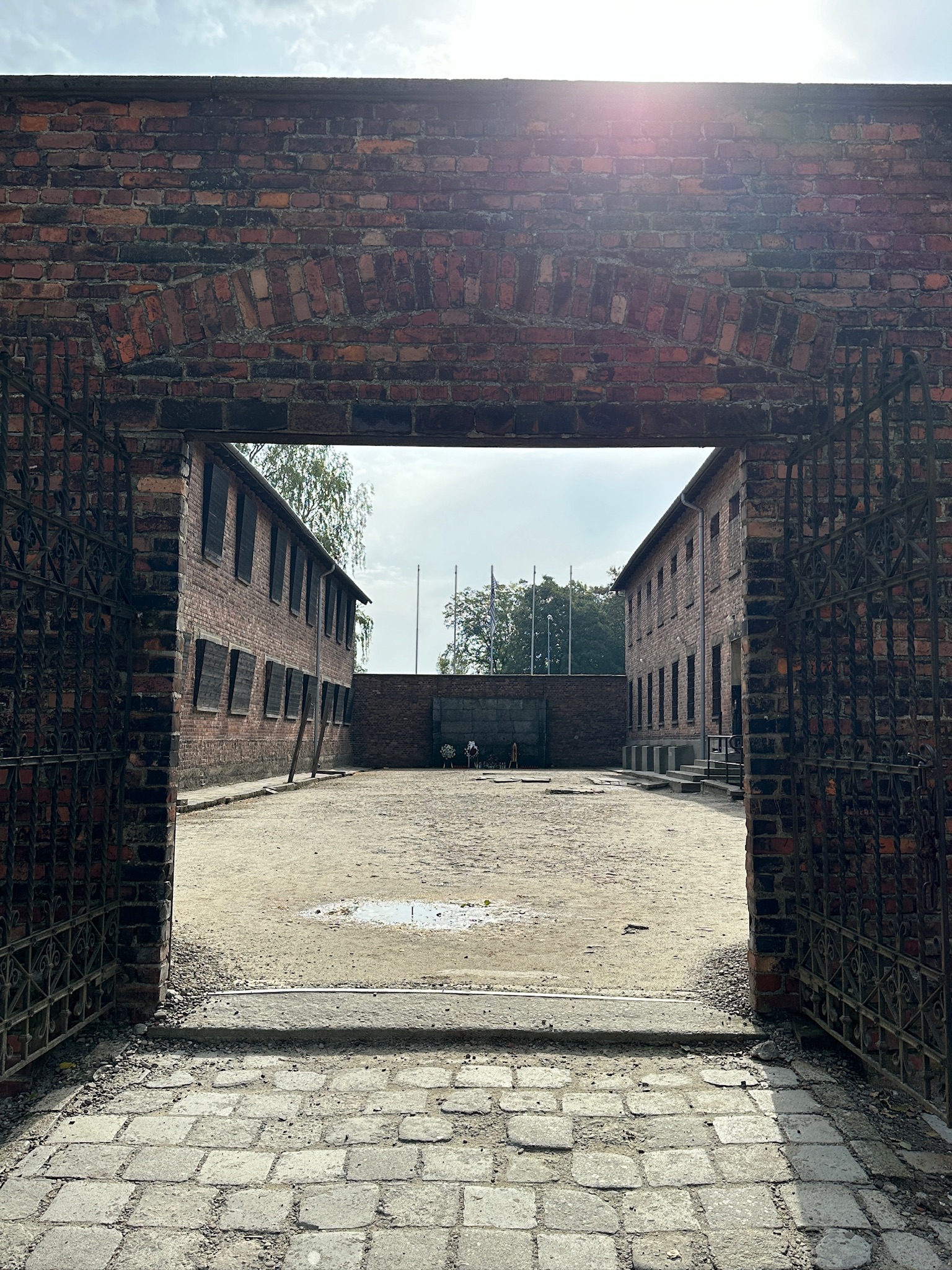
*The courtyard where Fr. Maximilian traded his life for his fellow man.
Gajowniczek later recalled: ‘I could only thank him with my eyes. I was stunned and could hardly grasp what was going on. The immensity of it: I, the condemned, am to live and someone else willingly and voluntarily offers his life for me – a stranger. Is this some dream? I was put back into my place without having had time to say anything to Maximilian Kolbe. I was saved. And I owe to him the fact that I could tell you all this. The news quickly spread all round the camp. It was the first and the last time that such an incident happened in the whole history of Auschwitz. ‘For a long time I felt remorse when I thought of Maximilian. By allowing myself to be saved, I had signed his death warrant. But now, on reflection, I understood that a man like him could not have done otherwise. Perhaps he thought that as a priest his place was beside the condemned men to help them keep hope. In fact he was with them to the last.’‘
Father Kolbe was thrown down the stairs of Building 13 along with the other victims and simply left there to starve. Hunger and thirst soon gnawed at the men. Some drank their own urine, others licked moisture on the dank walls. Maximilian Kolbe encouraged the others with prayers, psalms, and meditations on the Passion of Christ. After two weeks, only four were alive. The cell was needed for more victims, and the camp executioner, a common criminal called Bock, came in and injected a lethal dose of carbolic acid into the left arm of each of the four dying men. Kolbe was the only one still fully conscious and with a prayer on his lips, the last prisoner raised his arm for the executioner. His wait was over …
A personal testimony about the way Maximilian Kolbe met death is given by Bruno Borgowiec, one of the few Poles who were assigned to render service to the starvation bunker. He told it to his parish priest before he died in 1947: ‘The ten condemned to death went through terrible days. From the underground cell in which they were shut up there continually arose the echo of prayers and canticles. The man in-charge of emptying the buckets of urine found them always empty. Thirst drove the prisoners to drink the contents. Since they had grown very weak, prayers were now only whispered. At every inspection, when almost all the others were now lying on the floor, Father Kolbe was seen kneeling or standing in the centre as he looked cheerfully in the face of the SS men. Father Kolbe never asked for anything and did not complain, rather he encouraged the others, saying that the fugitive might be found and then they would all be freed. One of the SS guards remarked: this priest is really a great man. We have never seen anyone like him … Two weeks passed in this way. Meanwhile one after another they died, until only Father Kolbe was left. This the authorities felt was too long. The cell was needed for new victims. So one day they brought in the head of the sick-quarters, a German named Bock, who gave Father Kolbe an injection of carbolic acid in the vein of his left arm. Father Kolbe, with a prayer on his lips, himself gave his arm to the executioner. Unable to watch this I left under the pretext of work to be done. Immediately after the SS men had left I returned to the cell, where I found Father Kolbe leaning in a sitting position against the back wall with his eyes open and his head drooping sideways. His face was calm and radiant ..’
So it was that Father Maximilian Kolbe was executed on 14 August, 1941 at the age of forty-seven years, a martyr of charity. The death certificate, as always made out with German precision, indicated the hour of death 12.30.
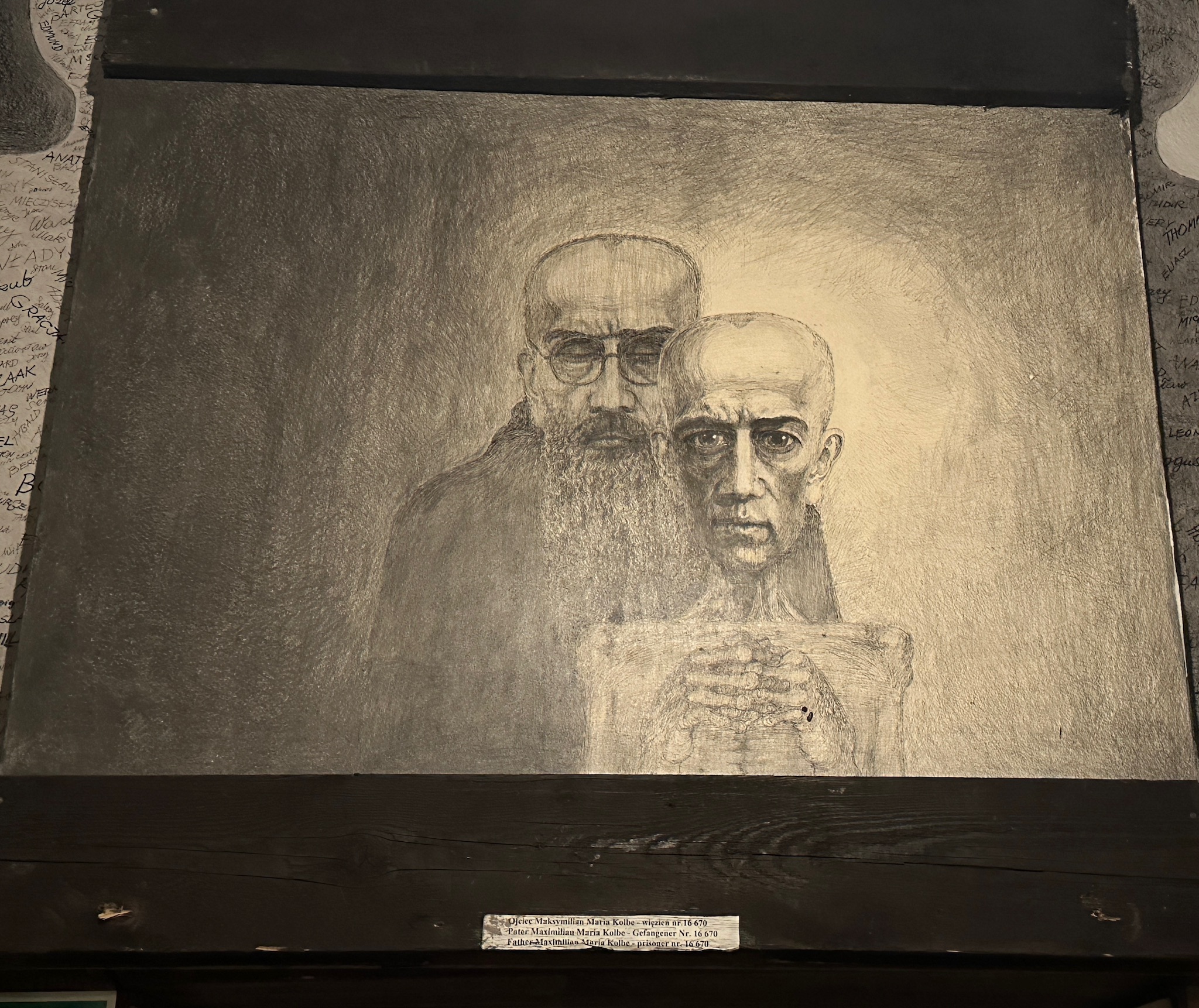
Father Kolbe’s body was removed to the crematorium, and without dignity or ceremony was disposed of, like hundreds of thousands who had gone before him, and hundreds of thousands more who would follow.
The heroism of Father Kolbe went echoing through Auschwitz. In that desert of hatred he had sown love. A survivor Jozef Stemler later recalled: ‘In the midst of a brutalization of thought, feeling and words such as had never before been known, man indeed became a ravening wolf in his relations with other men. And into this state of affairs came the heroic self-sacrifice of Father Kolbe.’ Another survivor Jerzy Bielecki declared that Father Kolbe’s death was ‘a shock filled with hope, bringing new life and strength … It was like a powerful shaft of light in the darkness of the camp.’
The cell where Father Kolbe died is now a shrine. We were blessed as pilgrims to visit and pray there during our visit. Maximilian Kolbe was beatified as Confessor by Paul VI in 1970, and canonized as Martyr by Pope John Paul II in 1981.
But what happened to Gajowniczek – the man Father Kolbe saved?
He died on March 13, 1995, at Brzeg in Poland, 95 years old – and 53 years after Kolbe had saved him. But he was never to forget the ragged monk. After his release from Auschwitz, Gajowniczek made his way back to his hometown, with the dream of seeing his family again. He found his wife but his two sons had been killed during the war. Every year on August 14 he went back to Auschwitz. He spent the next five decades paying homage to Father Kolbe, honoring the man who died on his behalf.
Father Kolbe’s incredible deed is an inspiration for all mankind. His life serves as eulogy to the millions who perished in World War II. He did not leave his legacy as an ode to the past – rather as a beacon of hope to the future …
Yesterday began the annual 9 day Novena to St. Maximilian Kolbe. Maximilian founded the Militia Immaculata movemnet, where he spread a fervent devotion to Our Lady which now has villages throughout the World. I have been praying with the Militia Immaculata since 2023. And I felt extremely humbled to stand in the cell where its founder lived out his final act of courage.
In honor of this courageous martyr I shall share with you, in the proceeding days, some of the encouraging words St. Maximilian left behind for his Militia and for all of us to reflect, pray and draw our own strength and courage from. May God pour out His graces upon you, as you read them.
St. Maximilian, pray for us!
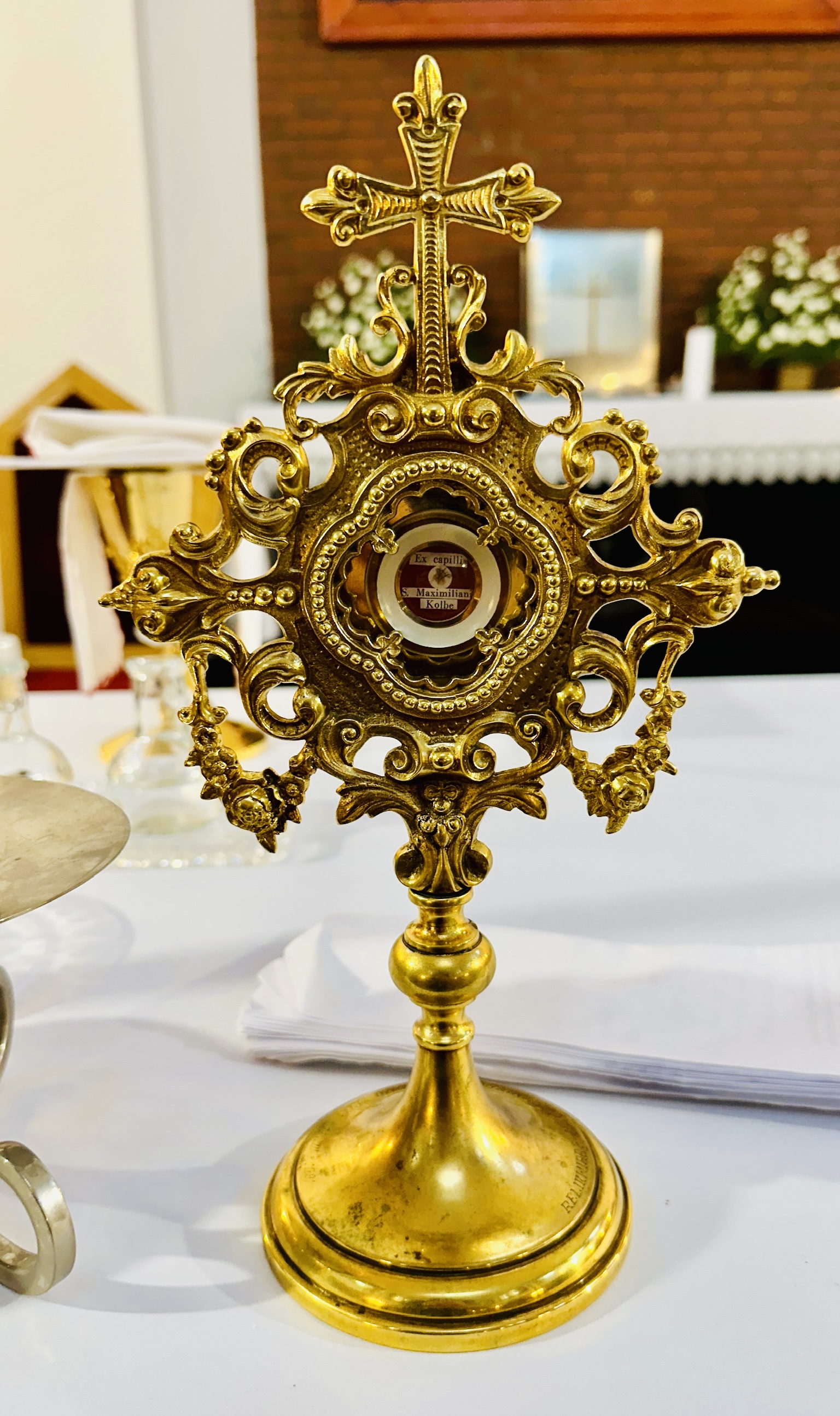
*A relic of St. Maximilian Kolbe at The Fransciscan Friary founded by him in Niepokalanow, Poland.
hugs n’ blessings for finding the courage we never knew we had.
*Pertinent information in this post gathered from auschwitz.org, encyclopedia.org, and auschwitz.dk.
 hugsnblessings
Thank you for writing and sharing.
LikeLike
this is a story that should be told and re-told so we never forget. you’ve recalled it all beautifully. the camp is a very hard place to go to indeed.
LikeLike