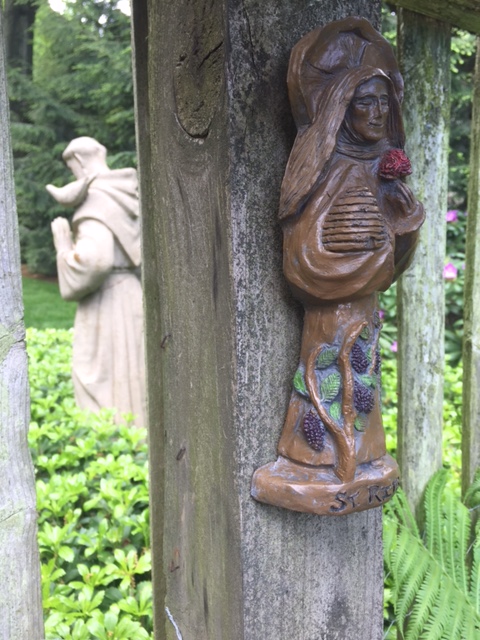
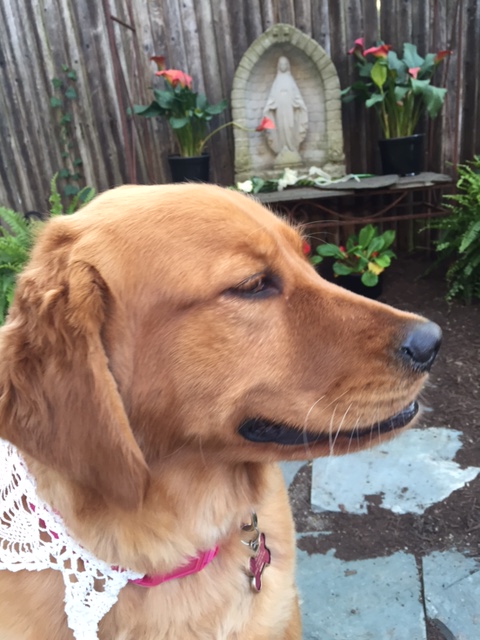
lover of animals; which is why he stands appropriately near
our bird-feeders.
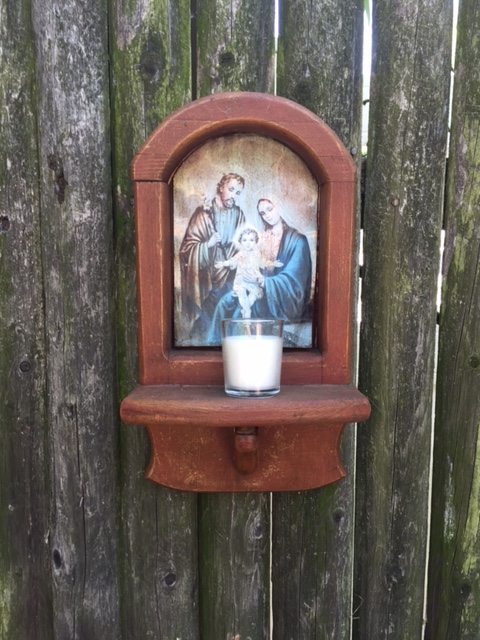
And St. Joseph, another favorite hero of mine and defender of the Holy Family,
hangs near a favorite sitting spot of Cuppycake’s & mine.
What is a Saint?
A saint is one who has been recognized for having an exceptional degree of holiness, sanctity, and virtue.
What is a Hero?
A person of distinguished courage or ability, admired for their brave deeds and noble qualities. 2. a person who, in the opinion of others, has heroic qualities or has performed a heroic act and is regarded as a model or ideal.
“I’m pretty sure I fit the criteria for both.”
And so it is for me that the two are synonymous as I have not met a Saint who has not qualified as Hero. And while Hero’s, on the other hand, aren’t always made a Saint…does that mean we all shouldn’t at least aspire to be one?
Our parish priest, Fr. Larry Richards, often reminds us we should all aspire to be Saints! That when we leave this earthly life our lives will have been so devoted to pointing always to Him, despite the trials we may face, that our parishes will be filled with statues of each one of us!
(I wrote in a previous post what I would envision my statue to denote.)
In our modern day vernacular we have made the term “SAINT” synonymous with perfection. If someone lives a life above reproach we say “He is a real saint,”
if one dedicates their life to solely doing good works, such as Mother Teresa, we say “She is a real saint,” if one lives a life exemplary of good morals and high standards we ascribe to them the “title” of saint.
We have set some pretty high standards for achieving sainthood!
(Rightfully so!)
And yet…
I do believe the Saints themselves would say quite differntly.
They would remind us that to attain Sainthood is a courageous battle to be fought daily, with great joy! That there is no perfection to be found in living the life of a Saint, only imperfect people (sinners) striving to love Him always…in ALL ways and doing so heroically!
Rejoice not over me, O my enemy; when I fall, I shall rise; when I sit in darkness, the Lord will be a light to me.
Michael 7:8
St. Paul himself, declares in Romans 7:15, this struggle to do good is difficult!
“I do not understand my own actions. For I do not do what I want, but I do the very thing I hate,” Romans 7:15
However, we should never stop trying!
Will we tire?
Yes.
Should we quit?
Never.
And that is exactly why the Saints are my heroes.
Heroes never quit!
They fall down…
and then
get up.
“Does the ‘no-quitting’ part include a dog-treat when I get back up again?”
In this past half-century I have met many Heroes!
All of whom I have drawn strength from at various moments of my life,
some more than others,
but each equally as important.
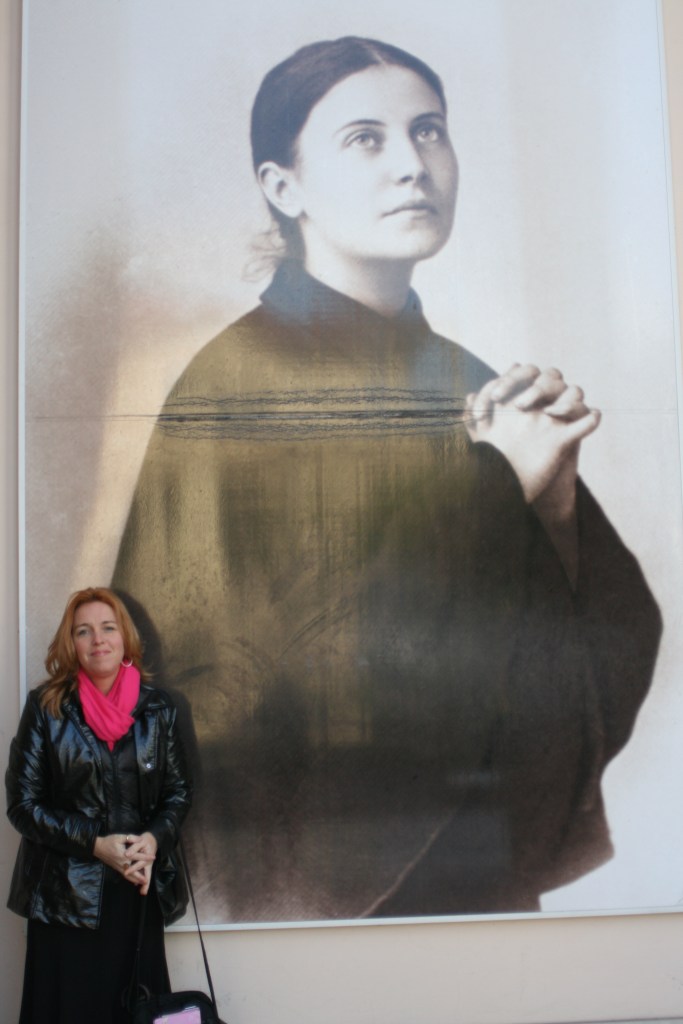
Outside the Shrine of St. Gemma Galgani in Lucca, Italy.
I hope you will find a hero (or more) to fall in love with!
Remember they are who we can draw strength from as we aspire to be
The term “agree to disagree” or “agreeing to disagree” is a phrase in English referring to the resolution of a conflict (usually a debate or quarrel) whereby all parties tolerate but do not accept the opposing position(s). It generally occurs when all sides recognise that further conflict would be unnecessary, ineffective or otherwise undesirable. They may also remain on amicable terms while continuing to disagree about the unresolved issues.
The phrase “agree to disagree” first appeared in print in 1770 when, at the death of George Whitefield, John Wesley wrote a memorial sermon which acknowledged, but downplayed, the two men’s doctrinal differences:
There are many doctrines of a less essential nature … In these we may think and let think; we may ‘agree to disagree.’ But, meantime, let us hold fast the essentials... Wikipedia
What’s this??
I VOTED TODAY!!!
I’ve not ever been one to immerse myself in politics. I personally have limited requirements for a candidate, so I most times shy away from engaging in conversations regarding the political arena. I do enjoy listening to the opinions of other’s & their politcal preferences; however, I rarely speak regarding who will receive my support (unless directly asked.)
This is often an area of discussion where I quietly excercise my right to “agree to disagree.”
This years’ primary, I needed to work a bit more & sift through the rhetoric to discover the key points that are critical for me in casting my single vote. And it was this very ‘thing’ which I was most struck by this voting cycle.
I am just one vote.
One vote in a sea of others across this great Nation.
Sounds so insignificant.
And yet…
So very powerful to the one who would receive it.
And who knows…
Maybe one day, if a life has been saved as a result,
that ‘One’ will change the world for the better.
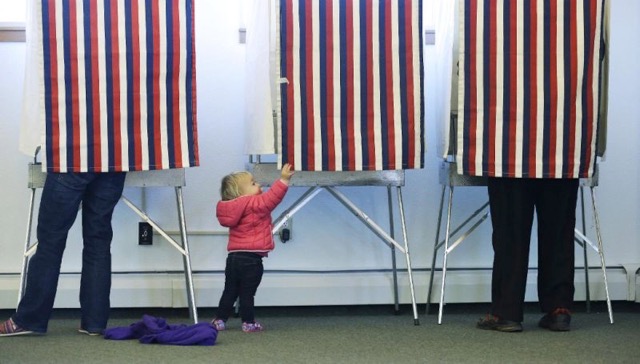
Photo Courtesy of Pinterest
We encourage all citizens, particularly Catholics, to embrace their citizenship not merely as a duty and privilege, but as an opportunity meaningfully to participate in building the culture of life. Every voice matters in the public forum. Every vote counts. Every act of responsible citizenship is an exercise of significant individual power. We must exercise that power in ways that defend human life, especially those of God’s children who are unborn, disabled or otherwise vulnerable. We get the public officials we deserve. Their virtue–or lack thereof–is a judgment not only on them, but on us. Because of this we urge our fellow citizens to see beyond party politics, to analyze campaign rhetoric critically and to choose their political leaders according to principle, not party affiliation or mere self-interest.
[Living the Gospel of Life: A Challenge to American Catholics 34, National Conference of Catholic Bishops, November 1998]
Our Duty to Vote
With the development of popular government comes the duty of citizens to participate in their own government for the sake of the common good. Not to do so is to abandon the political process to those who do not have the common good in mind. Given the nature of democracies this inevitably leads to unjust laws and an unjust society. These may come about anyway, but they should not come about through the negligence of Christians, who would then share in the guilt.
This duty is chiefly exercised by voting, through which citizens elect their representatives and even determine by referendum the laws which will govern them. The Catechism of the Catholic Church states:
2239 It is the duty of citizens to contribute along with the civil authorities to the good of society in a spirit of truth, justice, solidarity, and freedom. The love and service of one’s country follow from the duty of gratitude and belong to the order of charity. Submission to legitimate authorities and service of the common good require citizens to fulfill their roles in the life of the political community.
2240 Submission to authority and co-responsibility for the common good make it morally obligatory to pay taxes, to exercise the right to vote, and to defend one’s country [Rom 13:7]:
Pay to all of them their dues, taxes to whom taxes are due, revenue to whom revenue is due, respect to whom respect is due, honor to whom honor is due. [Christians] reside in their own nations, but as resident aliens. They participate in all things as citizens and endure all things as foreigners…. They obey the established laws and their way of life surpasses the laws…. So noble is the position to which God has assigned them that they are not allowed to desert it. [Ad Diognetum 5: 5, 10]
The Apostle exhorts us to offer prayers and thanksgiving for kings and all who exercise authority, “that we may lead a quiet and peaceable life, godly and respectful in every way.” [1 Tim 2:2]
In their November 1998 pastoral letter Living the Gospel of Life: A Challenge to American Catholics the Bishops of the United States speak of a false pluralism which undermines the moral convictions of Catholics and their obligation to be “leaven in society” through participation in the democratic process.
25. Today, Catholics risk cooperating in a false pluralism. Secular society will allow believers to have whatever moral convictions they please – as long as they keep them on the private preserves of their consciences, in their homes and in their churches, and out of the public arena. Democracy is not a substitute for morality. Its value stands – or falls – with the values which it embodies and promotes. Only tireless promotion of the truth about the human person can infuse democracy with the right values. This is what Jesus meant when he asked us to be a leaven in society. American Catholics have long sought to assimilate into U.S. cultural life. But in assimilating, we have too often been digested. We have been changed by our culture too much, and we have changed it not enough. If we are leaven, we must bring to our culture the whole Gospel, which is a Gospel of life and joy. That is our vocation as believers. And there is no better place to start than promoting the beauty and sanctity of human life. Those who would claim to promote the cause of life through violence or the threat of violence contradict this Gospel at its core.
Formal versus Material Cooperation in Evil
Voters are rightly concerned about the degree to which their vote represents cooperation in the evil which a candidate embraces. Obviously, voting for a candidate whose principles exactly coincide with Catholic teaching would eliminate that worry. However, that is a rare, if not non-existent, situation. Even those who embrace Catholic principles may not always apply them correctly. The fact is that most candidates will imperfectly embrace Catholic principles and voting for ANY candidate contains many unknowns about what that candidate believes and will do.
The moral distinction between formal and material cooperation allows Catholics to choose imperfect candidates as the means of limiting evil or preventing the election of a worse candidate. The justification of doing that is described above. Formal cooperation is that degree of cooperation in which my will embraces the evil object of another ‘s will. Thus, to vote for a candidate because he favors abortion is formal cooperation in his evil political acts. However, to vote for someone in order to limit a greater evil, that is, to restrict in so far as possible the evil that another candidate might do if elected, is to have a good purpose in voting. The voter’s will has as its object this limitation of evil and not the evil which the imperfect politician might do in his less than perfect adherence to Catholic moral principles. Such cooperation is called material, and is permitted for a serious reason, such as preventing the election of a worse candidate. [cf. Gospel of Life 74]
The Conscience Vote
Many Catholics are troubled by the idea of a lesser of two evils or material cooperation with evil. They conclude that they can only vote for a person whose position on the gravest issues, such as abortion, coincides exactly with Catholic teaching. To do otherwise is to betray their conscience and God.
Sometimes this view is based on ignorance of Catholic teaching, a sincere doubt that it is morally permissible to vote for someone who would allow abortion in some circumstances, even if otherwise generally pro-life. It is also perhaps the confusing expression “lesser of two evils,” which suggests the choice of evil. As I have explained above, the motive is really the choice of a good, the limitation of evil by a worse candidate.
Sometimes this view is motivated by scrupulosity – bad judgment on moral matters as to what is sin or not sin. The resulting fear of moral complicity in the defective pro-life position of a politician makes voting for him morally impossible. This situation is different than ignorance, however, in that the person simply can’t get past the fear of sinning, even when they know the truth.
However, I think it is most frequently motivated by a sincere desire to elect someone whose views they believe coincide best with Church teaching. This is certainly praiseworthy. Yet, human judgments in order to be prudent must take into account all the circumstances. Voting, like politics, involves a practical judgment about how to achieve the desired ends – in this case the end of abortion as soon as possible, the end of partial-birth abortion immediately if possible, and other pro-life political objectives. A conscience vote of this type could be justified if the voter reasonably felt that it could achieve the ends of voting. The question must be asked and answered, however, whether it will bring about the opposite of the goal of voting (the common good) through the election of the worst candidate. That, too, is part of the prudential judgment. In the end every voter must weigh all the factors and vote according to their well-informed conscience, their knowledge of the candidates and the foreseeable consequences of the election of each.
Answered by Colin B. Donovan, STL
A Call to Prayer First of all, then, I urge that entreaties and prayers, petitions and thanksgivings, be made on behalf of all men, for kings and all who are in authority, so that we may lead a tranquil and quiet life in all godliness and dignity.
1 Timothy 2:1-2
Voting would be so much easier, if only Helen were running!
Vote 4 me!
I am running for Vice President.
Vote 4 me!
I will give you one hundred percent.
Vote 4 me!
If you want changes made, I’m your (wo)man.
Vote 4 me!
I will serve any way that I can.
Oh wait up!
There is just one more thing, only one.
Vote 4 me!
My opponent is, well, sorta dumb.
(And besides, I’ll be handing out candy and gum.)
Susan Noyes Anderson on July 3, 2009.
hugs n’ blessings to all those honoring their right to vote!
(Even if you receive no candy or gum.)
Instead, may your (one) vote help to enrich the lives of those around you!
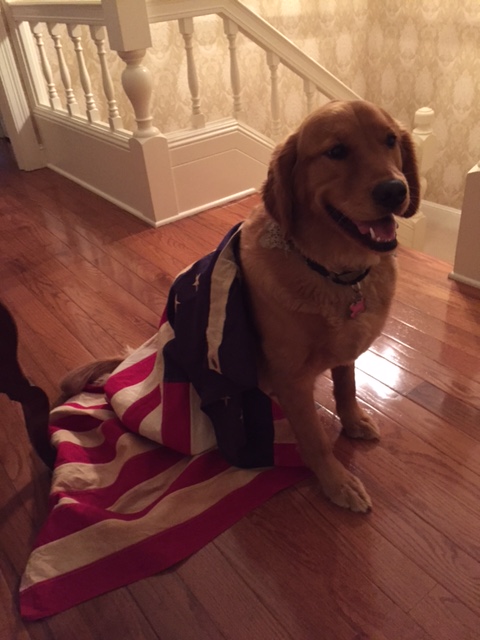
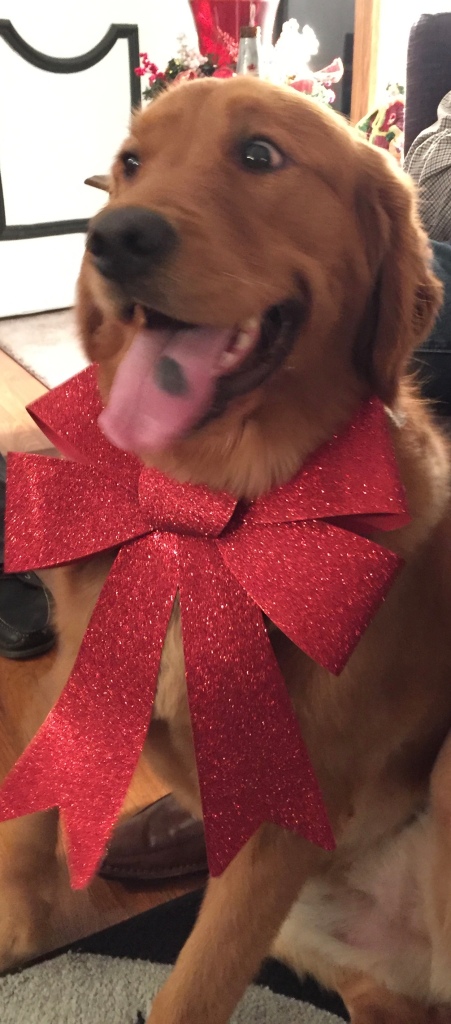
Helen, (the best golden-retreiver in the Universe) & I were just fortunate enough to be included in our Diocesean Faith Magazine along with her!!!
Faith Magazine of the Erie Catholic Diocese, the largest family publication in Northwest Pennsylvania, contacted us for an interview…and today the April edition was released with Helen & I in it!
FAITH Magazine was introduced in January 2005 by then-Bishop Donald Trautman. Today, Bishop Lawrence Persico serves as publisher of the award-winning magazine. All 62,000 Catholic households registered in parishes throughout the diocese receive the magazine, free of charge, every other month as part of a major restructuring of evangelization and communications strategies. Bishop Persico and the local parishes are committed to reaching out to every Catholic home with FAITH Magazine because they want to remind us that we belong to something — our local parish; and we belong to someone — Jesus Christ.
Why did the Diocese of Erie commit to FAITH Magazine?
Many Catholics attend Mass weekly and are active participants in their parishes. At the same time, a growing number of busy families and individuals find themselves participating in the life of the church less and less. Still others may have had a negative experience, become lukewarm or fallen away altogether. FAITH Magazine was created to reach out to all Catholics with stories of inspiration. The magazine is also designed as a formation tool, providing answers to common questions as well as a glimpse of international, national and local news.
The Diocese of Erie was the third diocese to affiliate with FAITH Magazine first published in the Diocese of Lansing, Michigan in 2000. Today that number has grown to more than two dozen dioceses and institutions! You will find that the major feature stories, as well as local news stories, are based in the Diocese of Erie. FAITH Magazine is part of the diocese’s answer to Pope John Paul II’s call for a “new evangelization.” The magazine is designed to touch the hearts of people both within and outside of the faith.
I have never been shy regarding my devotion to the Divine Mercy. And I truly enjoy cyber-journaling about my personal experience of growing closer to God as a result of this devotion. I usually dedicate any journaling I do on Wednsedays to this topic, which you can easily find under the Divine Mercy heading of my toolbar. However, I was completely surprised & humbled when asked to participate in a publication sharing tangible ways to explore mercy more fully.
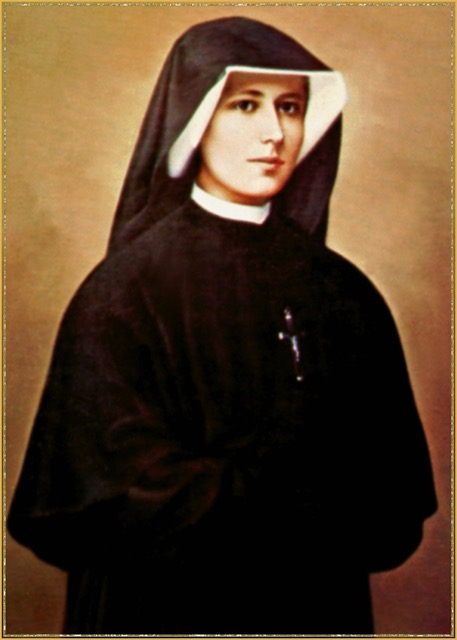
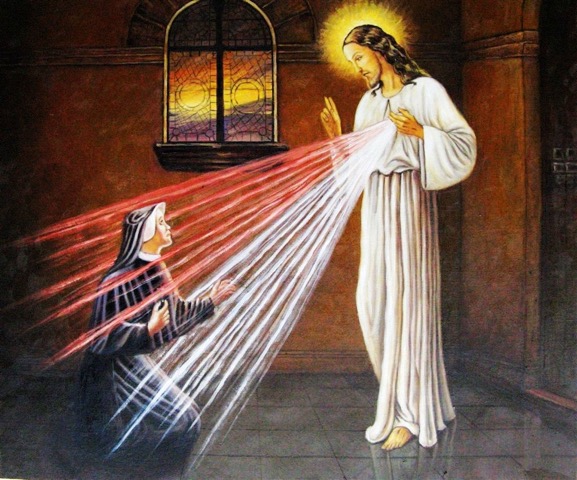
When Anne-Marie Welsh, editor of the magazine, interviewed me for the article I had not anticipated just how much JOY would leap out from inside of me, as we spoke of St. Faustina! I felt like a giddy-school-girl introducing her new BFF from summer camp to the friends I already knew well! Jesus said to St. Faustina: “Let no sinner be afraid to approach Me.” And by the grace of God, THAT IS NOW ME!!!
In Faustina’s “Diary,” Jesus invites each one of us to yield to His infinite mercy, to trust in His compassion and forgiveness. Great graces are promised to all those who proclaim His great mercy. And so it is, that I am resting in the peace which comes from trusting His unwavering love for me as I strive to know, to love, and to serve Him, despite my human inclination of falling into sin.
“I shall protect them Myself at the hour of death, as My own glory. And even if the sins of the soul are as dark as night, when the sinner turns to My mercy, he renders Me the greatest praise, and becomes the glory of My Passion. When a soul praises My goodness, Satan trembles before it and flees to the very bottom of hell” (Diary, 378).
One of the many things I have discovered, through reading the Diary of St. Faustina, is that the simple message of mercy is this:
That God loves us, all of us,no matter how great our sins!
He wants us to turn to Him so that He may bless us,
He wants us to recognize His mercy, andallow it to flow through us to others.
(As St. Faustina did.)
In this way, all will come to share in His joy!
God wants us to approach Him.
We need only repent of our sins and ask for His Mercy.
Are you ready to completely Trust?
God wants us to know the graces of His mercy,
which are merely dependent upon our trust in Him.
Jesus, I trust in you!
Will you?
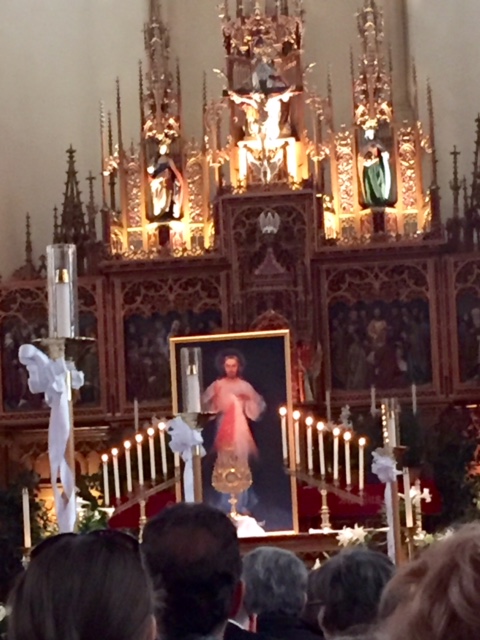
Divine Mercy Sunday, St. Joseph/BOL Erie, Pa
You never know…youmay be in a publication with Helen one day too!!
Auto-Paw-Graphs given on request!
hugs n’ blessings to all those who are trusting in Him!







 hugsnblessings