“You mean you’re not taking me with you to watch The Draft?”The NFL Draft, New York City, 2010
Our “very-own” calling the Steeler’s 6th round Draft Pick, Running-Back Jonathan Dwyer, circa 2010
Our family enjoys watching Sports!
(Well….except this guy.)
“I’d rather watch this water filter.” JDS
Preferably the Sport of football. Followed closely by basketball.
You will occassionally see us watching Hockey or Baseball but only Cuppycake finds pleasure in watching the sport of Golf.
(This is like watching paint dry for me!! ZERO enjoyment on the fun-meter!)
We both hold out hope that we will continue to travel around the country and watch these two particular sports, at the Collegiate level. We think it will be a WON-wonderful hobby for us to share together now that we are officially empty-nesters!
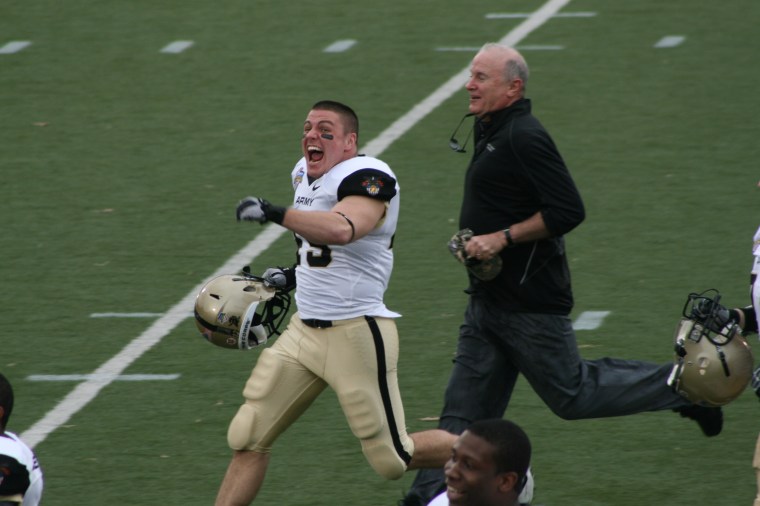
We’ve already visited a plethora of campuses & marked them off from our list, due mainly in part to THIS guy!
Army Wins the Armed Forces Bowl! 2010
And this girlie…
And even this cutie-pa-tootie too.
(Yes, the Debate Team is considered a Sporting Event.) Well…kind-of.
We can’t wait to get out our calendars & plan for the Campuses we shall visit this Season and the games we shall be cheering at!
It was no surprise then to find a few of us “Sports-Faithful” gathered together to partake in sharing the excitment of watching The Draft together!
Drafts for The Draft!
This guy shared all the necessary details regarding the pros & cons, stats & stories, as each player was chosen by their prospective new teams.
“This guy” with his Dad.
We love the part of listenting to the stories…but know we will have missed seeing them play now that they have moved into the professional arena of the Sport. The Collegiate level is where our hearts remain and how we enjoy watching the Sport. (Not that we still don’t enjoy watching anything Black & Gold with a Pittsburgh, Pa affliation! But mostly through the vehicle of a Telly. Giggles.)
How many little boy’s dreams were made as they heard their names called that night! How proud those who love them must have been to see this dream achieved. I pray they honor this new blessing they’ve been given…that they remain humble, that they give back to others (especially those who helped them along the way.) And that they MOST ESPECIALLY remember to give all the glory & honor to Him, who entrusted this talent to their care…
The arena of Sports is not the only opportunity for pride in our abilities.
In today’s culture Sports and Entertainment APPEAR to garner the most attention; however, there are many opportunities to exalt His name. I am convinced God uses ordinary people to carry out His extra-ordinary plan in the game of life.
Although this Weekend we were able to watch, yet once again another NFL Draft, we were truly blessed to watch three young men carry out His plan in very extra-ordinary ways!
And I couldn’t help but be so proud to watch them each be “Drafted” to do His will.
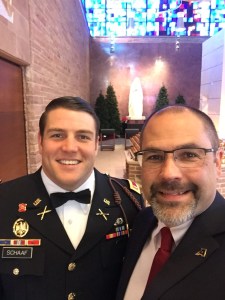
Our “very-own” promoted to Captain in the Army!
Hooah!
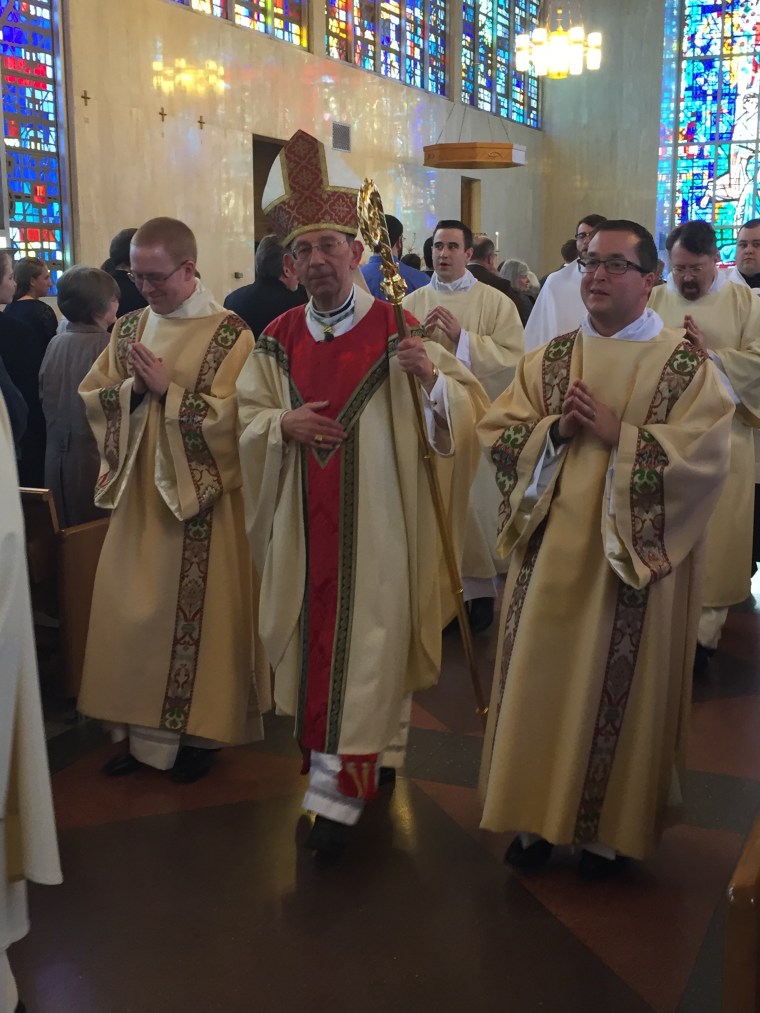
And two dear-friends newly Ordained as Deacons of the Diocese of Erie, Pa!
Amazing Grace!
God truly does use us in various ways!
hugs n’ blessings to all those using their talents on His playing field!!
If our prayer is “Dear God, please use me to be of Service,” then that is what we will be. And it is not for us to judge either the size or value of our gifts. Our job is to try to get out of the way, to defer to the Spirit moving within us and to become open channels for the flow of God’s love.” Marianne Williamson
The term “agree to disagree” or “agreeing to disagree” is a phrase in English referring to the resolution of a conflict (usually a debate or quarrel) whereby all parties tolerate but do not accept the opposing position(s). It generally occurs when all sides recognise that further conflict would be unnecessary, ineffective or otherwise undesirable. They may also remain on amicable terms while continuing to disagree about the unresolved issues.
The phrase “agree to disagree” first appeared in print in 1770 when, at the death of George Whitefield, John Wesley wrote a memorial sermon which acknowledged, but downplayed, the two men’s doctrinal differences:
There are many doctrines of a less essential nature … In these we may think and let think; we may ‘agree to disagree.’ But, meantime, let us hold fast the essentials... Wikipedia
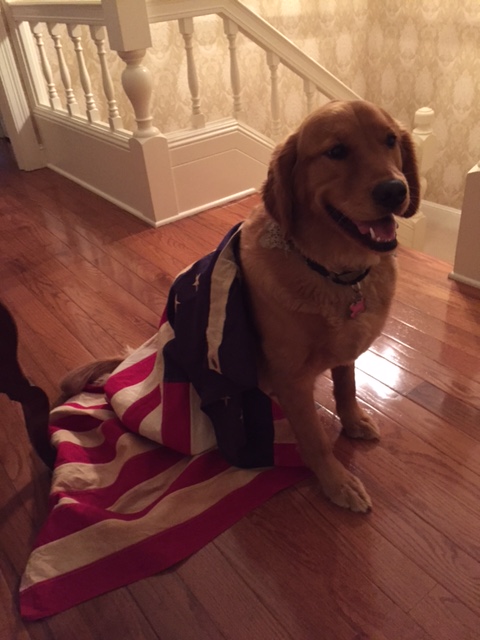
What’s this??
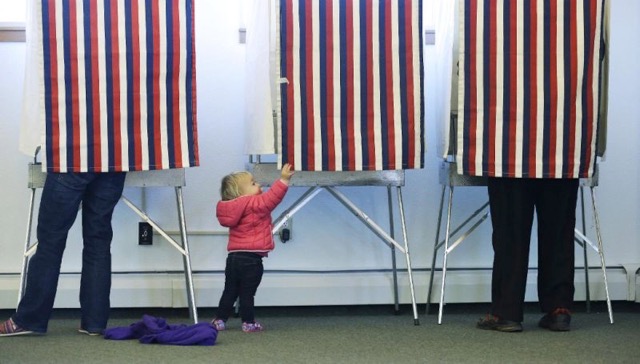
I VOTED TODAY!!!
I’ve not ever been one to immerse myself in politics. I personally have limited requirements for a candidate, so I most times shy away from engaging in conversations regarding the political arena. I do enjoy listening to the opinions of other’s & their politcal preferences; however, I rarely speak regarding who will receive my support (unless directly asked.)
This is often an area of discussion where I quietly excercise my right to “agree to disagree.”
This years’ primary, I needed to work a bit more & sift through the rhetoric to discover the key points that are critical for me in casting my single vote. And it was this very ‘thing’ which I was most struck by this voting cycle.
I am just one vote.
One vote in a sea of others across this great Nation.
Sounds so insignificant.
And yet…
So very powerful to the one who would receive it.
And who knows…
Maybe one day, if a life has been saved as a result,
that ‘One’ will change the world for the better.
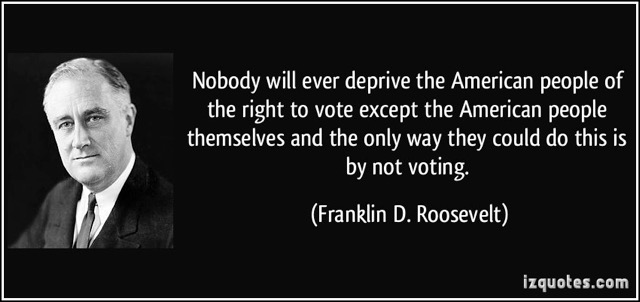
Photo Courtesy of Pinterest
We encourage all citizens, particularly Catholics, to embrace their citizenship not merely as a duty and privilege, but as an opportunity meaningfully to participate in building the culture of life. Every voice matters in the public forum. Every vote counts. Every act of responsible citizenship is an exercise of significant individual power. We must exercise that power in ways that defend human life, especially those of God’s children who are unborn, disabled or otherwise vulnerable. We get the public officials we deserve. Their virtue–or lack thereof–is a judgment not only on them, but on us. Because of this we urge our fellow citizens to see beyond party politics, to analyze campaign rhetoric critically and to choose their political leaders according to principle, not party affiliation or mere self-interest.
[Living the Gospel of Life: A Challenge to American Catholics 34, National Conference of Catholic Bishops, November 1998]
Our Duty to Vote
With the development of popular government comes the duty of citizens to participate in their own government for the sake of the common good. Not to do so is to abandon the political process to those who do not have the common good in mind. Given the nature of democracies this inevitably leads to unjust laws and an unjust society. These may come about anyway, but they should not come about through the negligence of Christians, who would then share in the guilt.
This duty is chiefly exercised by voting, through which citizens elect their representatives and even determine by referendum the laws which will govern them. The Catechism of the Catholic Church states:
2239 It is the duty of citizens to contribute along with the civil authorities to the good of society in a spirit of truth, justice, solidarity, and freedom. The love and service of one’s country follow from the duty of gratitude and belong to the order of charity. Submission to legitimate authorities and service of the common good require citizens to fulfill their roles in the life of the political community.
2240 Submission to authority and co-responsibility for the common good make it morally obligatory to pay taxes, to exercise the right to vote, and to defend one’s country [Rom 13:7]:
Pay to all of them their dues, taxes to whom taxes are due, revenue to whom revenue is due, respect to whom respect is due, honor to whom honor is due. [Christians] reside in their own nations, but as resident aliens. They participate in all things as citizens and endure all things as foreigners…. They obey the established laws and their way of life surpasses the laws…. So noble is the position to which God has assigned them that they are not allowed to desert it. [Ad Diognetum 5: 5, 10]
The Apostle exhorts us to offer prayers and thanksgiving for kings and all who exercise authority, “that we may lead a quiet and peaceable life, godly and respectful in every way.” [1 Tim 2:2]
In their November 1998 pastoral letter Living the Gospel of Life: A Challenge to American Catholics the Bishops of the United States speak of a false pluralism which undermines the moral convictions of Catholics and their obligation to be “leaven in society” through participation in the democratic process.
25. Today, Catholics risk cooperating in a false pluralism. Secular society will allow believers to have whatever moral convictions they please – as long as they keep them on the private preserves of their consciences, in their homes and in their churches, and out of the public arena. Democracy is not a substitute for morality. Its value stands – or falls – with the values which it embodies and promotes. Only tireless promotion of the truth about the human person can infuse democracy with the right values. This is what Jesus meant when he asked us to be a leaven in society. American Catholics have long sought to assimilate into U.S. cultural life. But in assimilating, we have too often been digested. We have been changed by our culture too much, and we have changed it not enough. If we are leaven, we must bring to our culture the whole Gospel, which is a Gospel of life and joy. That is our vocation as believers. And there is no better place to start than promoting the beauty and sanctity of human life. Those who would claim to promote the cause of life through violence or the threat of violence contradict this Gospel at its core.
Formal versus Material Cooperation in Evil
Voters are rightly concerned about the degree to which their vote represents cooperation in the evil which a candidate embraces. Obviously, voting for a candidate whose principles exactly coincide with Catholic teaching would eliminate that worry. However, that is a rare, if not non-existent, situation. Even those who embrace Catholic principles may not always apply them correctly. The fact is that most candidates will imperfectly embrace Catholic principles and voting for ANY candidate contains many unknowns about what that candidate believes and will do.
The moral distinction between formal and material cooperation allows Catholics to choose imperfect candidates as the means of limiting evil or preventing the election of a worse candidate. The justification of doing that is described above. Formal cooperation is that degree of cooperation in which my will embraces the evil object of another ‘s will. Thus, to vote for a candidate because he favors abortion is formal cooperation in his evil political acts. However, to vote for someone in order to limit a greater evil, that is, to restrict in so far as possible the evil that another candidate might do if elected, is to have a good purpose in voting. The voter’s will has as its object this limitation of evil and not the evil which the imperfect politician might do in his less than perfect adherence to Catholic moral principles. Such cooperation is called material, and is permitted for a serious reason, such as preventing the election of a worse candidate. [cf. Gospel of Life 74]
The Conscience Vote
Many Catholics are troubled by the idea of a lesser of two evils or material cooperation with evil. They conclude that they can only vote for a person whose position on the gravest issues, such as abortion, coincides exactly with Catholic teaching. To do otherwise is to betray their conscience and God.
Sometimes this view is based on ignorance of Catholic teaching, a sincere doubt that it is morally permissible to vote for someone who would allow abortion in some circumstances, even if otherwise generally pro-life. It is also perhaps the confusing expression “lesser of two evils,” which suggests the choice of evil. As I have explained above, the motive is really the choice of a good, the limitation of evil by a worse candidate.
Sometimes this view is motivated by scrupulosity – bad judgment on moral matters as to what is sin or not sin. The resulting fear of moral complicity in the defective pro-life position of a politician makes voting for him morally impossible. This situation is different than ignorance, however, in that the person simply can’t get past the fear of sinning, even when they know the truth.
However, I think it is most frequently motivated by a sincere desire to elect someone whose views they believe coincide best with Church teaching. This is certainly praiseworthy. Yet, human judgments in order to be prudent must take into account all the circumstances. Voting, like politics, involves a practical judgment about how to achieve the desired ends – in this case the end of abortion as soon as possible, the end of partial-birth abortion immediately if possible, and other pro-life political objectives. A conscience vote of this type could be justified if the voter reasonably felt that it could achieve the ends of voting. The question must be asked and answered, however, whether it will bring about the opposite of the goal of voting (the common good) through the election of the worst candidate. That, too, is part of the prudential judgment. In the end every voter must weigh all the factors and vote according to their well-informed conscience, their knowledge of the candidates and the foreseeable consequences of the election of each.
Answered by Colin B. Donovan, STL
A Call to Prayer First of all, then, I urge that entreaties and prayers, petitions and thanksgivings, be made on behalf of all men, for kings and all who are in authority, so that we may lead a tranquil and quiet life in all godliness and dignity.
1 Timothy 2:1-2
Voting would be so much easier, if only Helen were running!
Vote 4 me!
I am running for Vice President.
Vote 4 me!
I will give you one hundred percent.
Vote 4 me!
If you want changes made, I’m your (wo)man.
Vote 4 me!
I will serve any way that I can.
Oh wait up!
There is just one more thing, only one.
Vote 4 me!
My opponent is, well, sorta dumb.
(And besides, I’ll be handing out candy and gum.)
Susan Noyes Anderson on July 3, 2009.
hugs n’ blessings to all those honoring their right to vote!
(Even if you receive no candy or gum.)
Instead, may your (one) vote help to enrich the lives of those around you!











 hugsnblessings